A bathroom cleaner for hard water has to work on mineral, not on grease. USGS defines hardness as "the amount of dissolved calcium and magnesium in the water," and that mineral stays behind on glass and tile as the water dries. Soap scum sitting over it is a second deposit with its own chemistry, which is why one bottle rarely clears a shower.
What should a bathroom cleaner for hard water do?
It has to dissolve a mineral deposit and then rinse away clean. USGS explains where the mineral comes from in the first place: "as water moves through soil and rock it dissolves small amounts of naturally-occurring minerals and carries them into the groundwater supply." Heat concentrates the result, and "when hard water is heated, such as in a home water heater, solid deposits of calcium carbonate can form."
Virginia Cooperative Extension lists what that looks like in a bathroom: "reduced sudsing and cleaning action of soaps and detergents and buildup of soap scum or residue on hair, skin, laundry, plumbing fixtures, and cookware," plus "a mineral scale on the inside of pipes, cookware, and plumbing fixtures."
For the mineral half of the job, the trades reach for an acid. The Tile Council of North America says of mineral efflorescence that "generally efflorescence is removed with an acid." That is the one job in a routine clean where an acidic bathroom product earns its place — and the reason it has to be used with care rather than everywhere. If your home is on a septic system, the product-choice side of that decision is covered in our guide to septic-safe bathroom cleaners.
Does hard water cause soap scum?
Yes, and directly. USGS puts the reaction in one line: "in hard water, soap reacts with the calcium (which is relatively high in hard water) to form 'soap scum'."
That is the part people find surprising. The grey film on a shower wall is not dirt that was carried in, and it is not only the mineral. It is the soap itself, chemically changed by the calcium in the water, which is why water alone will not take it back off.
It also explains the feeling that you are using more product for less result. Virginia Cooperative Extension notes the reduced sudsing of soaps and detergents in hard water, so more soap goes in, and more scum comes out of it.
What is the difference between soap scum and hard-water scale?
One is mineral, the other is soap bound to mineral, and they come off with different products.
| Deposit | What it is | What takes it off | Where it must not be used |
|---|---|---|---|
| Mineral scale | Calcium carbonate left behind as hard water dries or is heated (USGS) | An acidic product, given its label dwell time, then rinsed (Tile Council of North America) | Grout joints, and marble, travertine or limestone (Natural Stone Institute) |
| Soap scum | Soap reacted with the calcium in hard water (USGS) | A non-acidic soap scum remover, or a solution of ammonia and water (Natural Stone Institute) | Never alongside any bleach product (Natural Stone Institute) |
| Both together, the usual case | A soap film with mineral set into it | Clear the scum first, rinse, then treat whatever mineral is still visible | — |
Most showers present both, which is why a single pass with a single product leaves a haze. Work in that order and the second step has far less to do.
How do you remove soap scum from shower glass?
With a non-acidic product and patience rather than pressure. The Natural Stone Institute gives the method for scum directly: "use a non-acidic soap scum remover or a solution of ammonia and water (about 1/2 cup ammonia to a gallon of water)."
It adds a limit on that habit. "Frequent or over-use of an ammonia solution may eventually dull the surface of some stone types," so the ammonia route is for the glass and the enclosure, not for a stone curb or threshold. Where a bathroom has marble or another natural stone, the boundaries are set out in our guide to cleaners for marble, granite and quartz. The Institute also warns that "scouring powders or creams often contain abrasives that may scratch certain stones" — the same reason a scouring pad is the wrong answer on glass.
A sequence that holds up in a real enclosure:
- Clear the shelves and lift out the mat, so nothing is cleaned around.
- Apply to the walls first, then the enclosure floor, then the glass last, working top to bottom.
- Let the product dwell as long as the label says instead of adding more of it.
- Rinse properly. Residue that is not rinsed is the start of the next film.
- Dry the glass and the metal, by hand or with a squeegee, so the water does not leave its mineral behind again.
How do you clean grout in a shower?
With a soft brush and a cleaner that is not acidic, which is the opposite of the advice for scale on the glass an inch away. The Tile Council of North America is unambiguous: cement "is alkaline based and is dissolved by acids," so "it is better to clean grout with an alkaline cleaner than an acid based cleaner."
The Council acknowledges that installers sometimes use an acid on stubborn grout stains, and notes that "it is not recommended by the grout manufacturers" and that "acid that is too strong can strip some color out of grout." It also warns off oil or wax based cleaners, which "if not properly rinsed, will leave a sticky soap film" that "usually attracts dirt."
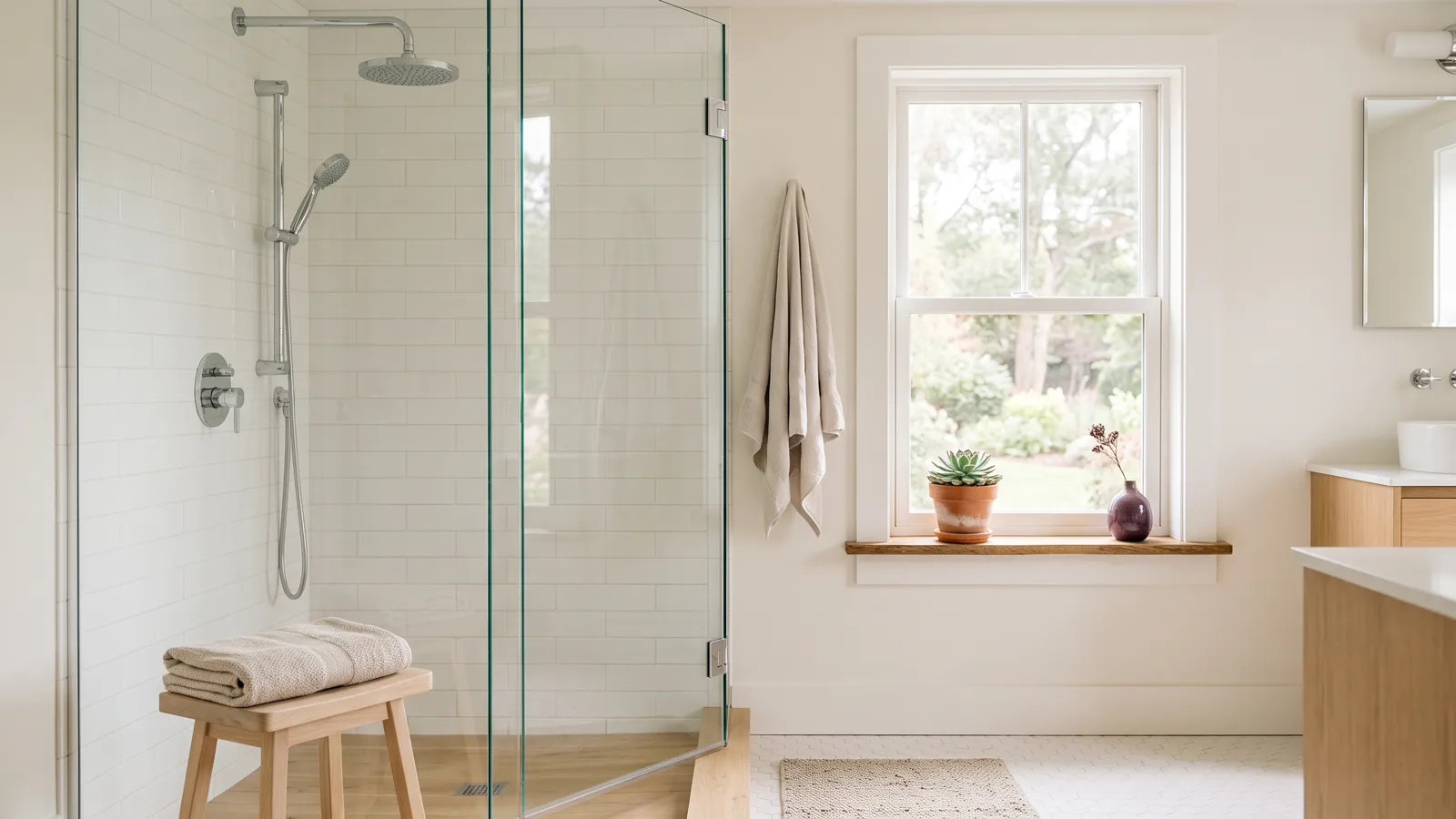
So on a tiled shower the acidic product belongs on the glass and the tile face, applied and rinsed rather than scrubbed down into the joints. The full method for tile and grout is in our guide to cleaning tile floors and grout, and sealing or regrouting is a tile trade rather than part of a cleaning visit.
Should you clean the bathroom before or after a shower?
After, as a matter of practice. The surfaces are already wet and warm, so a cleaner has an easier time getting under a film than it does on a dry, cold wall.
Then the room has to dry, and that is the half most people skip. EPA gives the instruction in four words: "run the bathroom fan or open the window when showering." It also sets the targets — "keep indoor humidity below 60 percent (ideally between 30 and 50 percent) relative humidity" — and the window that matters after a spill or a leak, since problems are largely avoided "if wet or damp materials or areas are dried 24-48 hours."
The Natural Stone Institute names the habit that does the most work in a shower: soap scum "can be minimized by using a squeegee after each use." A squeegee is not a flourish. It removes the water before the water can leave its mineral, which is the whole argument.
What is different about a New England bathroom
Hardness is local. USGS notes that "water hardness varies throughout the United States," and in a region where a great many homes draw from a private well, it can vary house to house. A well in Windham and a town supply in Methuen can leave quite different films on the same shower glass, so the right product is the one that matches your water rather than the one that worked at your last address.
Winter raises the stakes on the drying half. From November into mud season the windows stay shut and the house holds its moisture, so EPA's line about running the fan or opening the window is doing more work in January than in July.
How Andemora handles a shower on a visit
Supplies come with us and the products are safe for kids and pets. The enclosure is worked top to bottom, products are given their dwell time rather than doubled up, and abrasive products never touch natural stone or wood.
Under the Triple-A Standard, glass is left streak-free under side light and faucets and metals are dried and polished rather than left to air-dry, which on hard water is the difference between finished and spotted. Every room is re-checked against the checklist under room light and natural light before we lock up, and the home is left with a neutral clean scent rather than a heavy perfume.
A first Deep Clean is where set scale and old soap film get the time they need; a recurring Standard Cleaning holds the line afterwards. If hard water is the reason your shower never looks finished, mention it when you request an estimate, so the first visit is planned around it.
Frequently asked questions
Does a water softener make soap scum go away?
Softening is a water-treatment question rather than a cleaning one. USGS describes hardness as the dissolved calcium and magnesium in the water, so changing it means changing the supply, which belongs to a licensed well or plumbing professional.
Can you use vinegar on shower glass?
Vinegar is an acid, so it behaves like any other acidic product in the room. Keep it off marble, travertine and limestone, keep it out of grout joints, and never combine it with a bleach product, since CDC says not to mix products or chemicals with each other.
Will an abrasive pad take scale off glass?
It may take the shine with it. The Natural Stone Institute notes that scouring powders or creams often contain abrasives that may scratch certain stones, and the same caution applies to glass and glazed tile, so the answer is dwell time and a soft cloth instead of pressure.
How long should a cleaner sit on the deposit?
As long as the label says and no longer. CDC advises you to always read and follow the directions on the label, and the Tile Council of North America warns that an acid that is too strong can strip some color out of grout.
Sources
- Hardness of Water · USGS
- Hardness in Household Water · Virginia Cooperative Extension
- Learn About Cleaning Products for Natural Stone · Natural Stone Institute
- Cleaning Grout · Tile Council of North America
- A Brief Guide to Mold, Moisture and Your Home · EPA
- When and How to Clean and Disinfect Your Home · CDC