Deep cleaning a house with pets follows the same top-to-bottom order as any deep clean, with two changes. Hair and dander come off dry before any liquid touches a surface, and the animals wait in a closed room while you work. Soft surfaces get most of the time, and the floors come last.
How do you deep clean a house with pets?
Take the dry soil off first, work high to low, and leave the floors for the end. Hair moves as soon as you disturb it, so anything wet applied early glues it to a baseboard.
There is a reason to aim for removal rather than redistribution. The EPA states that proteins in your pet's skin flakes, urine, feces, saliva and hair can trigger asthma, and its broader indoor air guidance puts source removal first: usually the most effective way to improve indoor air quality is to eliminate individual sources of pollution or to reduce their emissions.
Here is the order that works in a home with animals. The full task list per room sits in what a deep clean includes.
- Settle the pets in one room with water and their bed, door closed. Do that room first or last.
- Strip the fabrics. Bedding, pet bed covers, throws, slipcovers and the door towel go in at once. The EPA's instruction for bedding is to wash it in hot water once a week and dry it completely.
- Dust high to low with a damp cloth, which the EPA recommends over a dry one: lampshades, shelf and frame tops, blinds, vent covers.
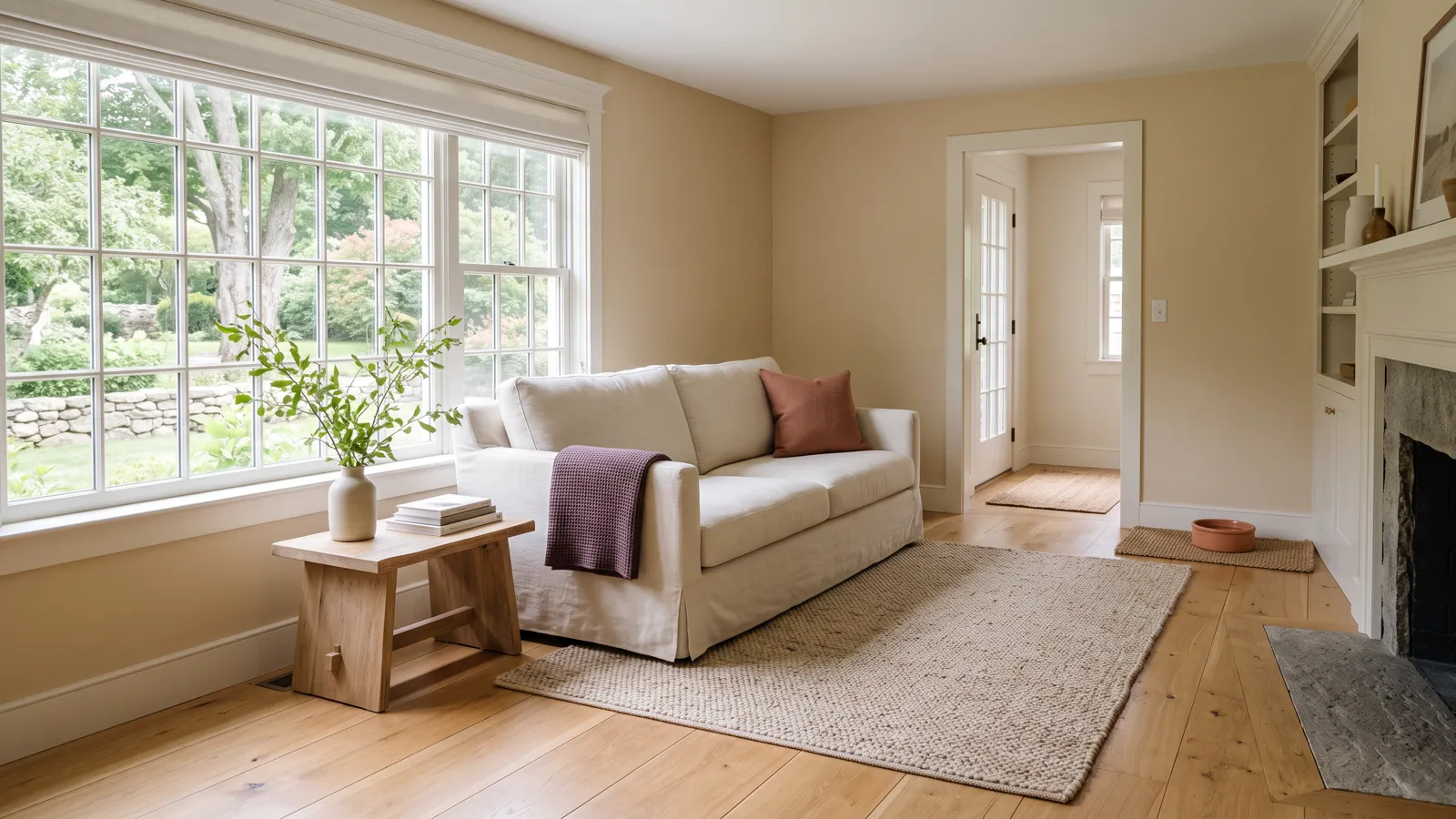
- Vacuum the soft furniture before anything wet happens: seams first with the crevice tool, then the faces, then under the cushions.
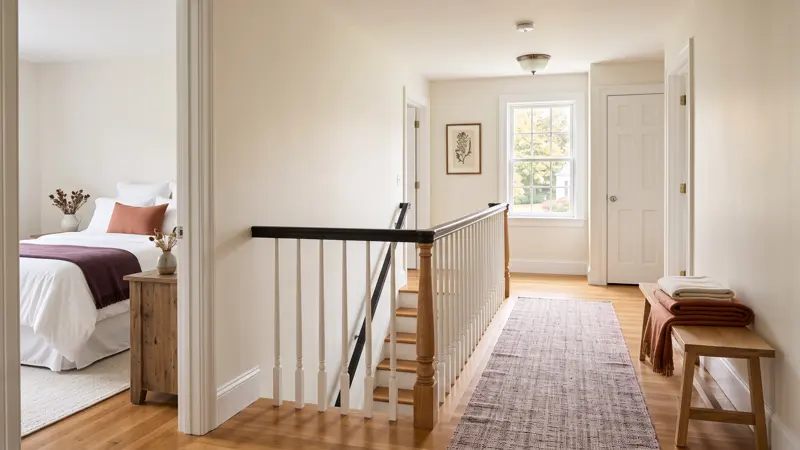
- Vacuum the edges of the room: baseboards, stair corners and treads, under furniture edges, behind doors, under the entry mat.
- Then the wet work on hard surfaces: switch plates, door frames and handles, glass, counters.
- Feeding area and litter box area, with their own cloths and water.
- Floors last, vacuumed and then mopped, with the method matched to the surface.
- Wash your hands and close the bottles. Pets come back once the floors are dry.
Where do pet hair and dander collect?
On the soft and the low: fabric-covered furniture, rugs, pet beds, baseboards, stair corners and the edges of rooms where air movement pushes hair into a line.
Dander is the part people underestimate. Illinois Extension writes that the cause of pet allergies is usually not fur but pet dander, flakes of dead skin, and that animal dander can remain in an environment for at least six months even after the pet has been removed. It is light, it settles everywhere, and a dry duster only moves it.
| Room | What a deep clean adds in a home with animals |
|---|---|
| Living and family rooms | Upholstery seams and under the cushions with the crevice tool, throws washed, rug edges, under and behind furniture, vent covers |
| Bedrooms | Bedding washed hot and dried fully, under the bed, fabric headboards and bed skirts, closet floor |
| Entry and stairs | Mat lifted and the floor beneath it, stair corners and risers, baseboards, the door towel |
| Kitchen | Feeding area floor and the wall behind it, bowls and mats washed away from the food-prep sink, bin inside and out |
| Bathrooms and laundry | Litter box area floor and baseboards, dryer lint trap, hair at the base of the toilet and tub |
| Hallways and vents | Vent covers and returns wiped, the furnace filter checked, hair along the edges of the run |
How do you get pet hair off soft surfaces?
Dry, with suction, and in more than one pass. The EPA recommends using a vacuum with a HEPA filter on carpet and fabric-covered furniture to reduce dust build-up, and vacuuming carpets and furniture every week.
- Run the crevice tool along the seams and the piping first, where hair braids itself into the fabric.
- Move slowly. Suction works on contact time; a fast pass lifts the top layer only.
- Shake a pet bed cover out before it goes in the washing machine, so the hair does not end up in the machine.
- Use a damp cloth or a lint roller on lampshades, curtain hems and stair runners, where a vacuum head cannot sit flat.
- Empty the canister part-way through. A full vacuum stops pulling.
What actually removes pet odor?
Taking away what is making it. The EPA ranks eliminating or reducing the source ahead of ventilation and air cleaners, and in a home with animals the list is short: the litter box, the pet bed, bowls and mats, the kitchen bin, a damp towel by the door, and the vacuum itself.
Filters are support, not a substitute. For a central system the EPA suggests a filter rated at least MERV 13, or as high as your system will accommodate, and is blunt about the limit: filtration does not replace the need to control pollutants and ventilate.
Adding scent is the opposite move. A heavy fragrance sits on top of the odor and gives you both, and in a home with cats it is worth less than clean air through an open window. The cat-specific caution sits in what hardwood floor cleaner is safe for pets.
How should the litter box and feeding area be cleaned?
Daily for the box, and never in the kitchen sink. The CDC says to clean the cat's litter box daily to lower the chances of exposure to harmful parasites, to keep pets and their supplies out of the kitchen, and never to clean supplies in the kitchen sink, food preparation areas, or the bathroom sink.
Daily is not an arbitrary number. On its toxoplasmosis page the CDC explains that the parasite does not become infectious until one to five days after a cat sheds it in its feces, which is why the box is changed before that window closes.
The practical version in a deep clean:
- Bowls, mats and toys are washed in a laundry or utility sink, or a dedicated basin, not where food is prepared.
- The floor and the wall behind the feeding station get their own cloth, since splash marks dry on at knee height.
- The litter box area is its own zone: floor, baseboard and the wall beside it.
- Hands are washed with soap and water after handling pet food, equipment or anything from the box.
Which cleaning products are safe to use around pets?
The one on the label, used the way the label says. EPA guidance for pet owners is to read the label first before you buy, store and use household cleaners, to follow all label instructions and precautions, and to keep pets and children away from treated areas as directed.
Three more lines from the same page belong inside the cabinet door. Keep all products out of the reach of pets and children, and in their original containers. After a spill, keep animals out of the area until it is cleaned up. Keep your veterinarian's number and a poison control number by the phone, with the product label in hand when you call.
What is different about a home with pets in New England?
Winter arrives on four paws. From December through March, sand, road salt and meltwater come in from the driveway several times a day, and mud season repeats it wetter. A mat inside and outside each door, plus a towel by the door for paws, stops most of it at the threshold.
Then there are ticks. The CDC advises checking pets who go outdoors daily for ticks, and notes that pets can transport ticks from outside the home to inside, where the ticks may then bite people. Its check list includes in and around the ears, around the eyelids, under the collar, under the front legs, between the toes and around the tail. After a wooded walk in Windham or Chelmsford, that check matters more than the floor does.
How often the whole reset is worth repeating is covered in how often you should deep clean.
How Andemora handles homes with pets
Supplies come with us, and the products we use are safe for kids and pets. Soft surfaces are vacuumed with the crevice tool along the seams, baseboards and stair corners are done by hand, and floors come last in every room. Bowls, beds and toys go back in their exact place, the way every personal item does.
The scent we leave is neutral, never a heavy perfume. Before we lock up, each room is re-checked against the checklist under room light and natural light, and you get a message that the home is ready.
Every new client starts with a Deep Clean, which sets the level, and recurring weekly, bi-weekly or monthly visits hold it. Inside the microwave is part of every visit; inside the refrigerator and inside the oven are add-ons, quoted by condition; cabinet interiors and pantry organization are arranged separately. If you would like a home with animals handled this way, you can request an estimate.
Frequently asked questions
Does a deep clean get rid of pet allergens for good?
It removes what has collected, not the source. Illinois Extension notes that animal dander can remain in an environment for at least six months even after the pet has been removed, so recurring vacuuming and washing are what hold the level once a deep clean has set it.
Should I have the carpets or upholstery shampooed?
That is extraction work, booked on its own with a specialist, and it is separate from a cleaning visit. For routine care the EPA recommends vacuuming carpets and furniture every week with a HEPA-filter vacuum.
Do air purifiers help in a house with pets?
They help with particles, and they do not replace the cleaning. The EPA is direct about it: filtration does not replace the need to control pollutants and ventilate with clean outdoor air.
Can I use a disinfectant where my dog eats?
Usually you do not need to. The CDC describes cleaning with water, soap and scrubbing as what removes germs and dirt, and reserves disinfecting for when someone is sick. If you do use a disinfectant, follow the label and keep it out of reach of pets.
Does more than one animal mean deep cleaning more often?
Usually the soft surfaces need attention sooner, not the whole house. Rugs, pet beds and fabric-covered furniture are the parts that fill up first, while hard surfaces hold their level about as long as they would in any home.
Sources
- Asthma Triggers: Gain Control · EPA
- Improving Indoor Air Quality · EPA
- Guide to Air Cleaners in the Home · EPA
- Read the Label First: Protect Your Pets · EPA
- About Healthy Pets, Healthy People · CDC
- Preventing Toxoplasmosis · CDC
- Preventing Ticks on Pets · CDC
- When and How to Clean and Disinfect Your Home · CDC
- Pets and Allergies: What Are Pet Allergies · University of Illinois Extension